Caribbean Partnership Wins UN Award for Climate Adaptation Innovation
The Caribbean Biodiversity Fund’s Ecosystem-based Adaptation Facility has been recognized with a 2025 UN SIDS Partnership Award for its success in building measurable regional climate change adaptation and mitigation.
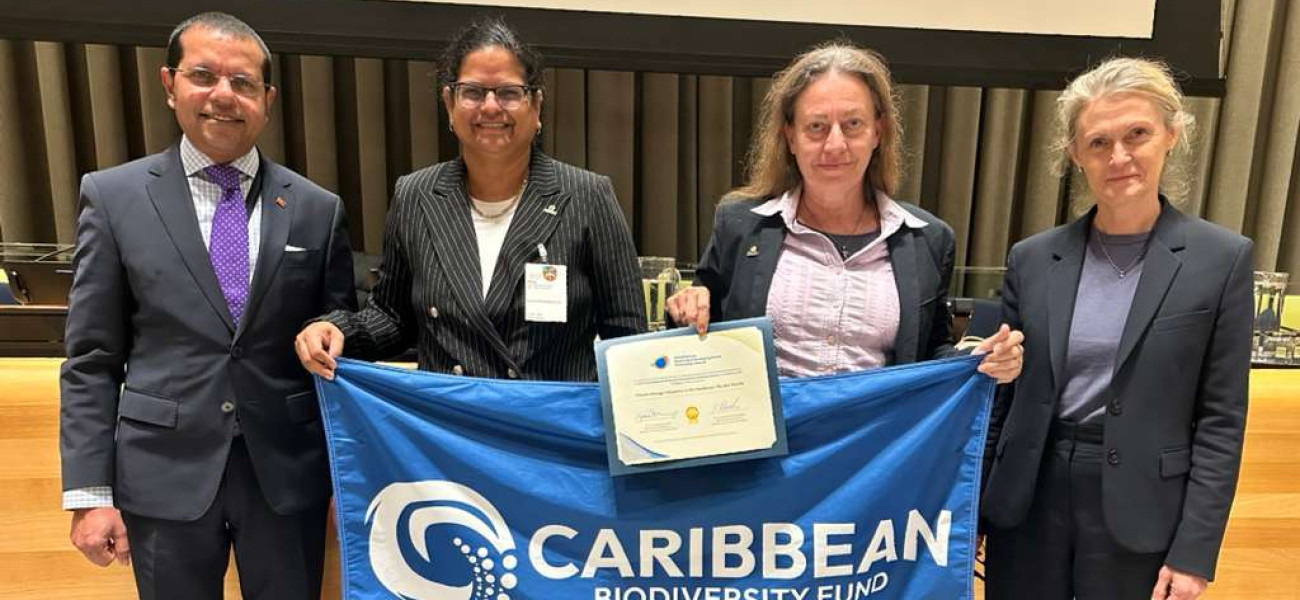
His Excellency Mr. Ali Naseer Mohamed, Permanent Representative of the Maldives to the United Nations, Caribbean Biodiversity Fund CEO Karen McDonald Gayle, Caribbean Biodiversity Fund Climate Change Program Manager Ulrike Krauss and Sanita Pavlutta-Deslandes, Permanent Representative of Latvia to the United Nations © Asha-Gaye Cowell
At a ceremony in New York on December 12, 2025, the Caribbean Biodiversity Fund (CBF) received the 2025 United Nations SIDS Partnership Award in the environmental category. The award recognized the CBF’s Ecosystem-based Adaptation Facility, which finances nature-based climate solutions across Small Island Developing States.
Since 2016, the EbA Facility has committed more than USD 45 million to 34 projects in 14 Caribbean countries. These investments have strengthened the management or protection of over 60,000 hectares of coral reefs, mangroves, and coastal ecosystems. More than 36,000 people have directly benefited, including over 16,000 women through livelihood support, climate risk reduction, and biodiversity conservation initiatives.
Caribbean reefs have declined by more than 50 percent since the 1970s, according to the Global Coral Reef Monitoring Network. In the Dominican Republic, practitioners have perfected an AI-assisted, remotely controllable land-based coral rearing facility—technology that is now being transferred to partners across the region. Cuban scientists, trained by Dominican peers in sexual coral reproduction techniques, developed their innovation further by creating a national coral spawning calendar for Cuba. Another EbA grantee in Jamaica is advancing cost-effective coral propagation methods while Eastern Caribbean teams are piloting assisted gene flow to strengthen coral resilience. In Saint Lucia, community vetiver grass planting reduced soil erosion and protected water infrastructure resulting in the national water company adopting the approach.
Beyond grants, the Facility convenes 40 past and present grantees and partners through a regional network and connects more than 100 practitioners through the Caribbean Coral Health Forum. With operations secured through 2030, the CBF’s EbA Facility continues to scale proven adaptation and mitigation models across the Caribbean at a time when climate change impacts are accelerating.
The EbA Facility is supported by Germany’s Federal Ministry for the Environment, Climate Action, Nature Conservation and Nuclear Safety through the International Climate Initiative and KfW Development Bank.
- Country: Cuba, Jamaica, Dominican Republic, Saint Vincent and Grenadines, Saint Lucia
- Project:
- Contact:
Dr Ulrike Krauss
Climate Change Program Manager, Caribbean Biodiversity Fund